Appointments Currently Available | We're Currently Accepting New Patients


Hearing Loss & Brain Health: The Hidden Connection
As a Hearing Instrument Specialist, it’s crucial for me to stay up to date on the latest news in the hearing health world. From the newest advancements in technology to innovations in diagnosing hearing challenges, I track the recent news to help our Tobermory community hear the life they love most.
Here at our clinic, I educate patients all about ear health alongside running diagnostic assessments and fitting hearing aids. Connecting with my community through the work I do is the most rewarding aspect; getting to advocate for hearing health optimization for my neighbours allows me to continue to reduce the stigmas attached to hearing challenges.
I recently had the opportunity to present some of the latest findings to the Tobermory Health Services Auxiliary, including information about hearing challenges, links to brain health, and how you can optimize both simultaneously with the help of expert hearing care.
Thanks to Brad Gibbs, who coordinated the event, I was privileged enough to give a presentation that exhibited my passions for hearing healthcare and also encouraged participants at the event to further understand how hearing challenges affect far more than just your ears!
How the Ear Works: How Does Hearing Loss Happen?
The ear has three main parts: the outer ear, the middle ear, and the inner ear. The outer ear catches sound waves that then travel into the inner ear, where the tiniest bones in the body reside: the malleus, incus, and the stapes (or the hammer, anvil, and stirrup).
Did you know that the stapes is the smallest bone in the body, but it’s one of the most important bones in helping you hear?
The malleus, incus, and stapes work together to transform sound waves into stimuli that travel through the cochlea in the inner ear, then head to the brain to allow you to hear birdsong, someone calling your name, or the doorbell ringing.
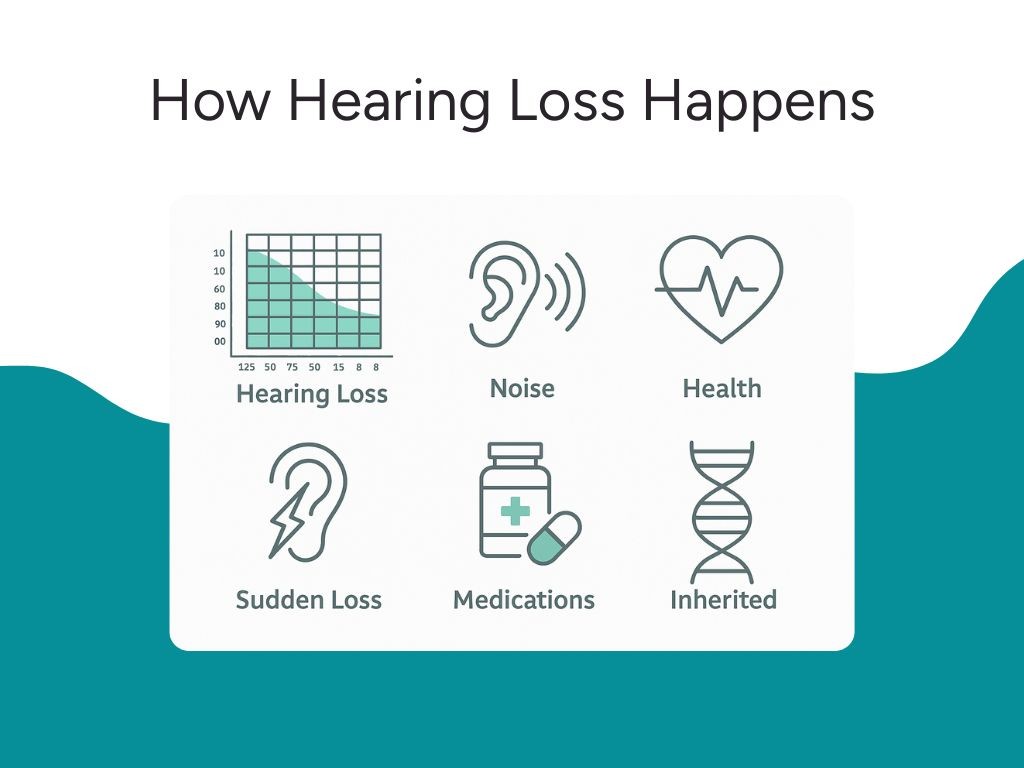
Hearing challenges happen when there are interruptions to this process. Hearing loss can be caused by several things, including health challenges, medication side effects (such as ototoxic medication used in cancer treatment), loud noise exposure, and genetic predispositions.
Sudden sensorineural hearing loss can be challenging, as it often comes about after health complications like viral infections, autoimmune reactions, circulation challenges, or inner ear inflammation. It is a rapid decrease that can be treated with medication and monitoring by experts.
It’s important to recognize that hearing challenges affect far more than just hearing the doorbell. For example, hearing loss can lead to negative effects on your brain health and ability to remember conversations and vital information.
Your ears and brain work together when you listen, helping you orient yourself in your environment, recognize the sounds around you, focus on what’s important, and separate relevant noise from background stimuli.
Your ears do the hearing, but your brain does the listening. The two are intertwined in a way that means if your ears are struggling, your brain will be, too.
Hearing the Trends in Canada
If you’re struggling with hearing challenges, you’re not alone. In Canada, 5.6 percent of people aged 15 and over had some form of hearing challenge in 2022.
Approximately 38 percent of adults aged 20-79 had measurable hearing loss. That number increases to 51 percent when you look just at adults aged 50-59, then to 77 percent for adults aged 60-69.
Hearing challenges have long been linked to dementia and memory loss, as the temporal lobe in the brain is responsible for both hearing and memory. When your hearing is struggling, your brain struggles in tandem, which can lead to:
Increased cognitive effort: When you struggle to hear, your brain works harder to fill in the gaps, which can get exhausting.
Reduced brain stimulation: Less sound input leads to decreased stimulation, impacting your brain’s functional patterns.
Impact on memory and cognition: Prolonged strain and lack of stimulation can make your brain vulnerable to memory and cognitive difficulties.
Good hearing can help improve your cognition, but good cognition can also help improve your hearing, especially in complex listening spaces.
The more severe your hearing challenges, the higher your risk of dementia, especially if those challenges are not treated properly by an expert hearing care professional.
Ready to Hear the Life You Love?
Early intervention in your hearing health allows you to not only hear your world with enhanced clarity, but also to stay engaged in it without struggle.
With strong hearing, your social engagements remain entertaining, not isolating: Your brain thrives on memories of loved ones at the dining table, and you enjoy quality time with your family even more when you can hear the voices around you.
Think of the whole-body connection. When you take care of all of you, all of you loves you back! With exercise, a healthy diet, and proper care for your brain health, your holistic well-being is bolstered, allowing you to take part in your busy lifestyle without interruption or constantly asking, “What did you say?”
It’s important for you, whether you’re a working professional, a retiree enjoying some time off, or someone exposed to loud noise on the daily, to take care of your hearing health. Your entire body will thank you!
When Was Your Last Hearing Assessment?
If you’re curious about your hearing health, think you may be struggling with some form of hearing challenges, or want a baseline assessment of your current hearing capabilities, you’re in the right place.
Rest assured that our team of experts is here to help you with every step of your hearing health journey, from your first assessment to your most recent follow-up. With the help of professional hearing care, you can safeguard both your hearing health and your brain health with confidence!
Request a callback to get in touch with our team or give us a call at (519) 534-1818.
Frequently Asked Questions (FAQ)
Q: How does hearing loss affect brain health?
A: Hearing loss can lead to changes in the brain’s structure and function. When the brain receives fewer auditory signals, it may reallocate resources to process other senses, potentially increasing the risk of cognitive decline and conditions like dementia. Addressing hearing loss early can help maintain healthy brain activity.
Q: Can untreated hearing loss increase the risk of cognitive decline or dementia?
A: Yes, research shows that untreated hearing loss is associated with a higher risk of cognitive decline and dementia. Struggling to hear can lead to social isolation and reduced mental stimulation, both of which are important for maintaining brain health.
Q: What steps can I take to protect my brain health if I have hearing loss?
A: If you experience hearing loss, seek professional evaluation and consider hearing aids or assistive devices. Staying socially active, engaging in mentally stimulating activities, and addressing hearing challenges promptly can all help support long-term brain health.
Source
Johns Hopkins Medicine: This comprehensive overview of the link between hearing challenges and dementia acknowledges the risk of untreated hearing loss on brain health and advocates for early action to help slow or prevent memory issues and cognitive decline.

Hearing Instrument Specialist and Local Business Owner
Thank you for reading! I have lived in the area for 10 years, and I am happy to call Wiarton my home. I am so excited to be a part of Wiarton's healthcare community. I have been working in the hearing healthcare industry for over 17 years. I graduated in 2004 from Grant McEwan University. I love every minute of what I do.
